Marketplace management
Flipkart Seller Cancellation Policy 2026: What Existing Sellers Need to Know
Flipkart’s new seller-fines structure, effective 23 August 2026, puts fixed penalties on dispatch breaches and seller cancellations. Here is what existing sellers should change in their daily operations.
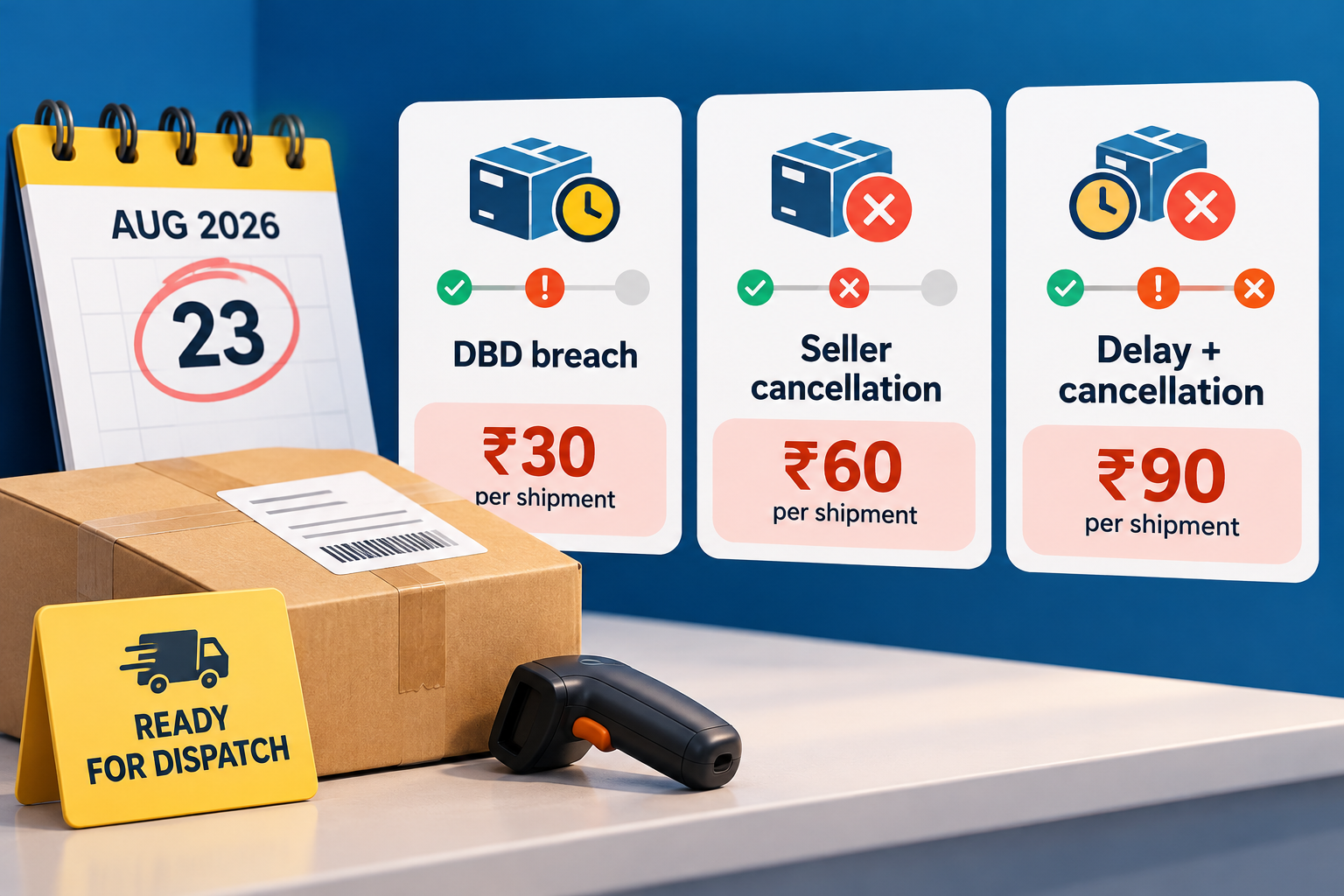
For existing Flipkart sellers, cancellations are no longer just an operational nuisance. From 23 August 2026, Flipkart introduced a fixed seller-fines structure covering missed Dispatch By Dates (DBD), seller-initiated cancellations and orders that move from a dispatch breach into cancellation. The practical message is simple: stock accuracy, packing speed and dispatch discipline now have a direct cost attached to them.
This article explains the change and, more importantly, what an established seller should change in day-to-day operations before the next busy sales period.
What changed on 23 August 2026?
The new structure uses three penalty levels for fulfilment failures:
| Situation | Reported penalty |
|---|---|
| Shipment is not ready for pickup by the committed Dispatch By Date | ₹30 per shipment |
| Seller cancels an order after receiving it | ₹60 per shipment |
| Order misses the DBD and is subsequently cancelled | ₹90 per shipment |
These figures have been reported by multiple Indian business publications covering Flipkart’s seller-policy change. Flipkart’s own seller materials also use DBD as a core order-management milestone, and its seller API documentation identifies seller cancellation as a distinct cancellation type.
The important operational change is that the financial impact is now easier to understand at the shipment level. Earlier, a DBD breach could lead to account restrictions or other operational consequences. The new model puts a defined monetary penalty on the affected shipment instead.
The policy is aimed at improving fulfilment reliability and customer experience, particularly during periods when order volumes rise.
For existing sellers, that makes prevention more valuable than reacting after an order has already gone wrong.
The three situations sellers need to watch
1. Missing the Dispatch By Date
The first risk is a straightforward dispatch breach. If an order is not made ready for pickup by its committed DBD, the reported penalty is ₹30 per shipment.
This can happen even when the seller eventually ships the product. A seller may have the correct stock but still miss the deadline because of late picking, packing delays, staff shortages or an order that was not noticed in time.
Flipkart’s order-management documentation confirms that shipments carry a dispatchByDate and that a shipment can move through states such as PACKED and READY_TO_DISPATCH.
That means your internal process should treat the DBD as an operational deadline, not merely an estimated date.
2. Seller cancellation
A seller cancellation is more expensive under the reported structure: ₹60 per shipment.
For many sellers, the underlying cause will be familiar: the listing showed stock that was not actually available, the wrong SKU was mapped, an item was damaged before dispatch, or inventory was sold through another channel before the Flipkart order was processed.
The key lesson is that inventory accuracy is part of order profitability. A sale that cannot be fulfilled can now create a direct penalty as well as the lost revenue and extra operational work associated with the cancellation.
3. Delay followed by cancellation
The highest reported penalty is ₹90 when an order first misses its DBD and is then cancelled.
This is particularly important because it connects two failures that sellers often manage separately: late fulfilment and cancellation.
If an order is already approaching or beyond its dispatch deadline, waiting for the problem to resolve itself can increase the cost. Sellers should therefore escalate at-risk orders early rather than discovering the problem after the DBD has passed.
What existing sellers should change now
The best response is not simply to tell staff to “avoid cancellations.” Build a process that makes avoidable cancellations less likely.
Keep inventory tighter than your marketplace listing
Review fast-moving SKUs regularly and reconcile Flipkart stock against your actual sellable inventory.
If you sell through multiple marketplaces, a stock-sync process becomes especially important. Even a small delay between an offline sale and an online inventory update can create an order that cannot be fulfilled.
Pay particular attention to:
- Fast-selling SKUs
- Low-stock products
- Variants with similar names
- Products sold across multiple channels
- Damaged or quarantined inventory that has not been removed from available stock
Create a daily DBD priority queue
Do not manage orders only by the time they arrive.
Create a simple daily queue based on DBD, with the most urgent shipments at the top. Orders approaching their deadline should be picked and packed before less urgent work.
A useful routine is:
- Check new orders.
- Sort pending orders by DBD.
- Identify stock or SKU exceptions.
- Pack orders that are closest to their deadline.
- Mark shipments correctly and prepare them for pickup.
- Escalate anything that cannot be fulfilled before the deadline.
This is particularly important during sales events, weekends and seasonal peaks when order volume can rise faster than your normal staffing capacity.
Track the reason behind every cancellation
A cancellation report should tell you more than the number of cancellations.
Record the actual operational cause: stock mismatch, damaged product, pricing issue, picking error, SKU mapping problem or another verified reason.
Then look for repeated patterns. If most cancellations come from three SKUs, the solution may be inventory control rather than additional manpower.
If most problems occur on one dispatch location or shift, the solution may be process design.
What about auto-cancellation?
Reports on the new structure state that an order can also attract a ₹60 cancellation penalty after repeated missed dispatch deadlines, with the combined delay-and-cancellation situation reported at ₹90.
Because the exact treatment of individual edge cases can depend on the seller’s account and the current Seller Hub communication, sellers should use the policy notice visible in their own Seller Hub as the final operational reference.
This is also why it is worth checking your account regularly rather than relying on older seller guides. Marketplace policies can change, and older advice may describe a previous enforcement model.
How to reduce your risk before festive sales
Existing sellers should treat the policy as a reason to strengthen fulfilment before volume increases.
A practical checklist:
- Audit your top-selling Flipkart SKUs for stock accuracy.
- Remove unavailable inventory promptly.
- Check that your packing team can handle peak-day order volume.
- Review DBD performance every day.
- Keep packaging materials ready for fast-moving products.
- Separate exceptions from normal orders so they are visible.
- Investigate every seller cancellation instead of treating it as routine.
- Keep records of dispatch and pickup issues.
- Review the latest policy notices in Seller Hub before major sales events.
The goal is not to eliminate every operational problem. It is to identify problems early enough that they do not become cancellations.
What sellers should take away
Flipkart’s 23 August 2026 seller-fines change makes fulfilment discipline more measurable in financial terms. The reported penalties are ₹30 for a DBD breach, ₹60 for a seller cancellation and ₹90 where a delayed order is subsequently cancelled.
For an established seller, the biggest opportunity is operational rather than financial: keep inventory accurate, prioritise orders by DBD and investigate the reasons behind cancellations.
The change also reinforces an important marketplace principle: a healthy catalogue is not enough. Your ability to fulfil the orders you receive is part of running a reliable marketplace business.
For reference, sellers can review Flipkart’s Order Management API documentation for the platform’s order states, dispatch dates and cancellation types. Flipkart’s official Sell on Flipkart channel has also published material explaining the new seller-fines system.
As a next step, review your last 30 days of Flipkart cancellations and DBD breaches. Group them by SKU and root cause, then fix the largest recurring cause first. That gives you a practical starting point for reducing avoidable penalties before your next high-volume sales period.